Most adult golfers need at least 9 feet of ceiling height for a home golf simulator, with 10 feet being the comfortable target to swing a driver freely. The limiting moment is not the top of the backswing but the transition, where the clubhead arcs highest and fastest behind your head. Your own height and swing shape move that number more than any chart can.
Ceiling height is the first measurement I take in any room, because it is the one constraint you usually cannot engineer around. You can build a narrower enclosure or shorten a screen offset, but you cannot raise a basement joist. This guide gives you the real numbers by golfer height, the free test that beats every generic chart, the hidden inches you lose to flooring and the enclosure frame, and what to do when the ceiling comes up short.
How Much Ceiling Height You Actually Need
For a conventional standing swing with a driver, plan on 9 feet minimum and 10 feet comfortable for an average-height adult. A taller player with an upright swing can need a genuine 10 feet or more, while a shorter player with a flatter, rotary swing may be fine closer to 8 foot 6. These are clearance figures to the lowest obstruction, not to the structural ceiling.
The reason the range is so wide is that ceiling demand is driven by your swing arc, and arc scales with arm length, club length, and how upright you swing. Two golfers of the same height can differ by half a foot in the clearance they need. That is why I never hand someone a single number off a brochure — I hand them the test below, because their own arc is the only figure that matters when a mis-measured ceiling means a driver into a light fixture.
The Free Test That Beats Every Chart
Before you commit to a space, do this: stand at your planned hitting position, take your driver, and make a slow, full swing while a helper marks the highest point the clubhead reaches against the wall behind and above you. Add about four to six inches of margin, because your real swing is faster and longer than your careful demo one. That marked height plus margin is your true ceiling requirement.
This test costs nothing and removes all the guesswork that height charts introduce. It automatically accounts for your arm length, your shaft length, your posture, and your swing plane — every variable a chart has to average away. I run this same test in every room I build and re-run it whenever I change the hitting mat, because the mat height changes the answer. Trust the tape on your own swing over any table on the internet, including the one above.

The Hidden Inches You Lose
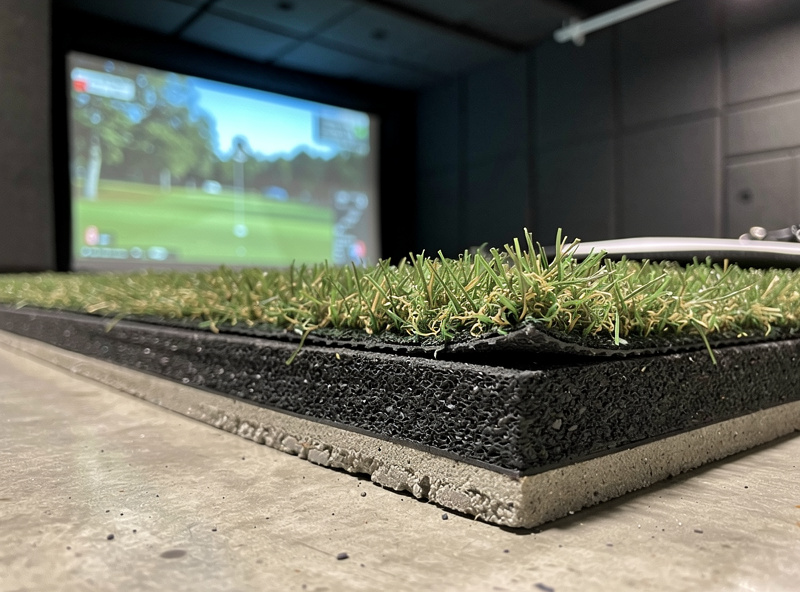
The ceiling number on the listing is rarely the number you swing under. You lose height in three predictable places: the floor build-up of a hitting mat and any sub-floor or impact-absorbing base, the enclosure frame’s top bar that hangs below the true ceiling, and any fixture, duct, beam, or garage-door track that intrudes into the swing path. Together these commonly eat three to six inches of usable clearance.
Measure to the lowest hard point your clubhead could meet, then subtract the floor build-up your stance will add. A room that reads 9 feet to the joist can easily become 8 foot 6 of real swing clearance once a one-inch mat sits on a two-inch base under a frame bar. This is the single most common way people end up clipping the ceiling in a room they “measured.” Account for it on paper and you will never be surprised in the build. The same floor-height tax shows up across the whole room, which is why I treat it as a first-class number in the overall room requirements guide.
Ceiling Height by Golfer Height
Use these as starting estimates only — the swing test above overrides them. The figures assume a full driver swing and include a small margin, but an upright swing or a fast tempo can push any row higher.
| Golfer Height | Typical Minimum | Comfortable | Notes |
|---|---|---|---|
| Under 5 ft 6 | 8 ft 6 | 9 ft | Flatter swings may fit tighter spaces |
| 5 ft 6 to 5 ft 11 | 9 ft | 9 ft 6 | The most common home build range |
| 6 ft to 6 ft 3 | 9 ft 6 | 10 ft | Upright swings need the full 10 ft |
| Over 6 ft 3 | 10 ft | 10 ft+ | Verify with the swing test before building |
When the Ceiling Comes Up Short
If your measured arc exceeds your available height, you are not automatically out of the game — but you are out of a conventional full-driver build, and pretending otherwise leads to dented ceilings and flinchy swings. The honest options are to choke down and shorten your effective swing, switch to shorter-shaft clubs, accept a driver-free practice room focused on irons and wedges, or choose a launch monitor that reads accurately on a restricted swing.
Each of those trade-offs has real consequences for the data you get and the practice that transfers outdoors. The key mindset is to design the room around the swing it can actually contain, rather than forcing a full driver into a space that physically cannot hold it. If the ceiling is your binding constraint, decide early whether you are building a full-driver room or an iron-and-wedge room, because that choice cascades into your screen, mat, and monitor decisions — all of which I tie together in the master room requirements guide.
Ceiling Height and Launch Monitor Choice
Ceiling height also interacts with the kind of launch monitor you can mount. Overhead photometric (camera) units need to be fixed at a stable height above the hitting zone, which is harder in a low room and can intrude into a tall player’s arc. Behind-ball radar units sit on the floor and free the ceiling entirely, which is often the better pick when height is your binding constraint. The trade-offs between budget radar and photometric units at different price points are worked through in the radar vs photometric budget guide.
This is why I size the monitor type and the ceiling together rather than choosing a monitor first and discovering the mount fights the swing. A restricted ceiling nudges you toward a floor-standing radar setup; a generous ceiling opens up the overhead-camera options. Either way, confirm the mount height against your swing test before you buy, because a monitor you cannot place where it reads accurately is a monitor that wasted your money.
Frequently Asked Questions
Is 8 foot ceiling enough for a golf simulator?
An 8-foot ceiling is tight and usually too low for a full driver swing by an average adult. Shorter players with flat swings sometimes manage, but most golfers at 8 feet should plan around choked-down swings, shorter clubs, or an iron-focused setup.
How do I measure the ceiling height I need for my swing?
Stand at the hitting position, make a slow full driver swing, and have a helper mark the highest clubhead point against the wall. Add four to six inches of margin for your faster real swing. That marked height is your true ceiling requirement.
Do taller golfers need higher ceilings?
Yes. Taller players and upright swings produce a higher swing arc, so a 6-foot-plus golfer often needs a genuine 10 feet where a shorter player is fine near 9. Always verify with the swing test rather than height alone.
Does the hitting mat reduce my usable ceiling height?
Yes. A hitting mat plus any sub-floor raises your stance and steals an inch or more of effective ceiling. Always measure to the lowest obstruction and then subtract the floor build-up your stance will add before deciding.
Can I use a golf simulator with a low ceiling at all?
Yes, with adjustments. Options include choking down, shorter-shaft clubs, an iron and wedge focus, or a radar monitor that reads a restricted swing. A full-speed driver in a too-low room is unsafe and should be avoided.
Keep Reading
More from This Cluster
- “Golf Simulator Room Depth: The Three Zones Explained”
- “Golf Simulator Screen Distance: Safe and Sharp”
- “The Garage Golf Simulator Reality Check”
- “Low-Ceiling Golf Simulator Options That Actually Work”
- “Room Width for a Golf Simulator: Centered and Safe”
- “Golf Simulator Room Requirements: The Complete Tape-Measure Guide”