The honest answer most apartment golfers do not want to hear: a full driver swing needs about 9 feet of ceiling, and the typical apartment runs 8 feet flat. That one foot is the single biggest thing standing between you and an indoor swing. The good news is that the ceiling decides what kind of sim you build, not whether you build one — and plenty of useful practice fits under 8 feet if you measure honestly first.
I live in Sweden, where the season is short and the indoor swing is the whole point. I have measured my own clearance with a club and a strip of tape more times than I will admit, and the number that matters is never the room height — it is the height your clubhead reaches at the top of your real swing. This guide is how to find that number and what to do with it.
How Much Ceiling Height an Apartment Golf Sim Really Needs
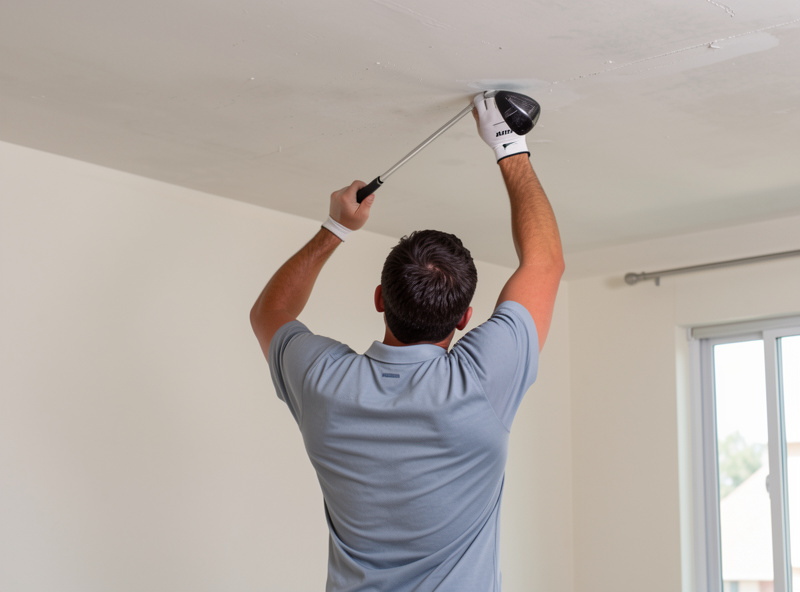
For a stock driver swing, most adults need roughly 9 feet, and 8.5 feet is the honest floor before the swing starts to feel pinched. Shorter players and shorter clubs need less; a wedge swing fits comfortably under 8 feet for nearly everyone. The constraint is your swing arc, not the net or the screen — the club rises behind and above your head, and that apex is what hits the ceiling.
This is exactly the same number I use for full enclosure builds, because the swing does not care whether there is a screen in front of it. My ceiling height guide works through it in detail, and the whole-room picture is in the tape-measure room requirements guide. For an apartment, the difference is that you usually cannot change the ceiling, so the number is a hard limit you design around.
Measure Your Real Swing Clearance, Not the Room
Do this before you buy anything. Stand where you would hit, take your normal backswing slowly, and have someone mark how high the clubhead reaches at the top — or hold the club at the top and measure to the head. That apex, not the room height, is your real clearance number. Add a few inches of safety margin because your live swing is faster and higher than your slow rehearsal.
The table below is the rough guide I start people with, but your measured number always wins. Height and swing style move it: a flat, rounded swing needs less ceiling than a steep, upright one, which is itself one of the workarounds further down.
| Club | Approx. ceiling for an average-height adult | Notes |
|---|---|---|
| Driver (full) | About 9 ft | The hardest club to fit; the apex is highest |
| Mid irons (full) | About 8.5 ft | Workable in many apartments with margin |
| Short irons | About 8 ft | Fits most standard ceilings |
| Wedges / partial | Under 8 ft | Comfortable for nearly everyone |
| Putting / chipping | Any height | No vertical clearance issue |
What Fits Under a Standard 8-Foot Ceiling
At a true 8 feet, most golfers can swing short irons and wedges with care, and full driver is off the table for an upright swinger. That is not the death of a sim — short-game and wedge work is the practice that moves scores most, and a launch monitor will gap your wedges to the yard, which is data you can rarely get on a range. A net-only wedge station under 8 feet is a genuinely productive winter setup.
If you want full-swing reps under 8 feet, you move into the workaround territory below or you accept a shortened club. I would rather hit honest half-wedges and track the data than fake a cramped driver swing that grooves a flat, ducking move I have to unlearn outdoors. My low-ceiling options guide covers the realistic paths in depth.
Workarounds That Actually Help
A few things genuinely buy you clearance, and a few are myths. What helps: a thinner mat (every inch of mat height is an inch of ceiling you lose), standing in the lowest part of a sloped or beamed ceiling, choking down on the club, and flattening your swing plane slightly. Shortened or single-length clubs lower the apex too, though they change your feel. What does not help: hoping your live swing is lower than your rehearsal — it is not, it is higher.
The honest trade with flattening or choking down is that you are practicing a slightly different swing than the one you take outdoors. I treat that as acceptable for winter maintenance — keeping the body moving and the gapping fresh — but I do not pretend the numbers transfer one-for-one. My practice-that-transfers guide is honest about which winter reps carry to the course and which are sim-flattery.
The Hazards Apartments Add Above Your Head
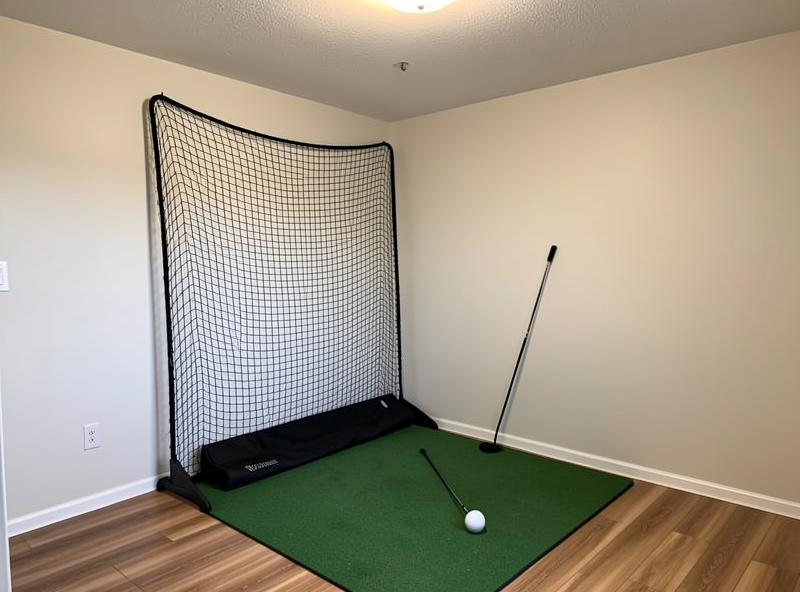
Apartment ceilings carry things a garage does not, and a clubhead at full speed finds them. Before the first swing, look up and clear the danger zone: a ceiling fan must come down or be off-limits, pendant and flush light fixtures are clubhead magnets, and a smoke detector takes a hit you will regret. The clearance you measured has to be clearance to the lowest object, not the drywall.
The one I treat as an absolute stop is a fire sprinkler head. If your unit has them, never set up where a swing or a stray club can reach one — a sheared sprinkler floods your apartment and the ones below it, and that is a building-wide disaster, not a dented ceiling. When in doubt, move the station to a room without a sprinkler in the swing zone. Side and bounce-back safety still apply too; the bounce-back safety guide covers the rest.
My Pick for a True 8-Foot Apartment
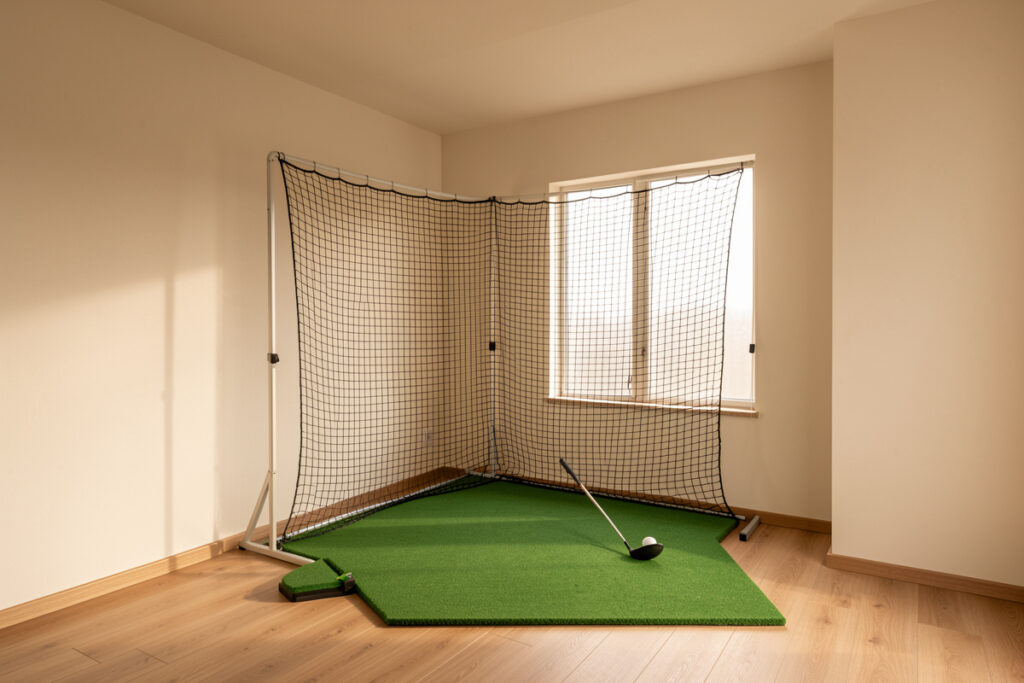
If I were setting up in a flat at a measured 8 feet today, I would build a wedge-and-short-iron net station and not fight the driver. Start with a thin mat — a 1/2 to 5/8-inch turf mat rather than a 1.5-inch premium pad, because that single inch of saved height is the difference between a comfortable 8-iron and a clipped ceiling. Stand on the bare floor, not a raised platform, for the same reason.
Pair it with a launch monitor that reads short shots cleanly. I run a Garmin Approach R10 for exactly this kind of compact station because it sits on the floor behind the ball and needs no ceiling mount or overhead space. Hang the net 8 to 10 feet ahead so a full short-iron has room to fly before it is caught, and keep the top two feet of wall clear of anything breakable. That is a setup that fits under 8 feet, stays safe, and still gaps every wedge to the yard through a five-month winter.
When the Ceiling Just Says No
Sometimes 8 feet and an upright full swing simply do not coexist safely, and the right call is to build the sim you can have rather than the one you want. That usually means a wedge-and-short-iron net station for winter maintenance, with full-swing work saved for a range or an outdoor day. It is also the moment some people decide a different room, a garage, or a future move is the real fix — my garage reality check is there if you have that option.
None of this is a reason to skip the launch monitor. Even a short-game-only apartment setup gives you carry numbers, dispersion, and a swing kept alive through a dead season — which, from a Swedish winter, is worth a great deal. Build to your real ceiling number and the setup will be safe, honest, and genuinely useful.
Frequently Asked Questions
Can you set up a golf simulator in an apartment with 8-foot ceilings?
Yes, for short irons, wedges and short-game work, which fit comfortably under 8 feet for most golfers. A full upright driver swing usually needs about 9 feet, so 8-foot apartments are best suited to a wedge-and-short-iron net station rather than full-swing driver practice.
How do I measure my real swing clearance for a low ceiling?
Take your normal backswing slowly and mark how high the clubhead reaches at the top, then add a few inches of margin because your live swing is faster and higher. That apex height, not the room height, is the number your setup must respect.
What golf clubs can I swing under an 8-foot ceiling?
Most golfers can swing short irons and wedges with care under a true 8 feet, plus all chipping and putting. Mid irons need closer to 8.5 feet and a full driver swing about 9 feet, so those are usually off the table in a standard apartment.
Does a thinner mat give me more ceiling height?
Yes. Every inch of mat height is an inch of clearance you lose, so a thinner mat directly buys swing room in a low apartment. Standing in the lowest part of a sloped ceiling and choking down on the club add a little more.
What should I check above my head before swinging indoors?
Clear ceiling fans, pendant and flush light fixtures, and smoke detectors from the swing zone, and never set up where a club can reach a fire sprinkler head. Your measured clearance must be to the lowest object, not just to the drywall.