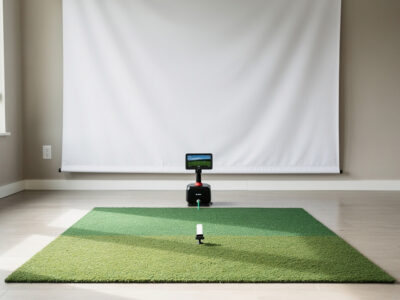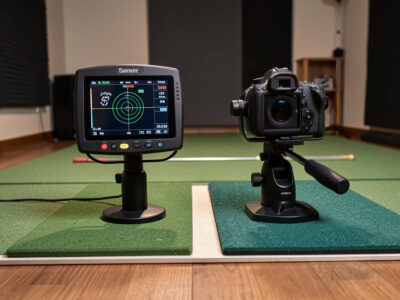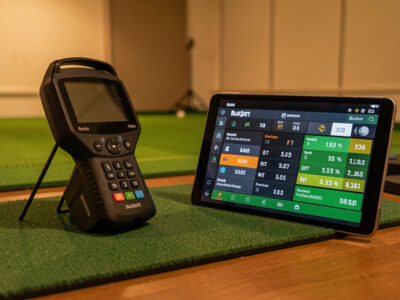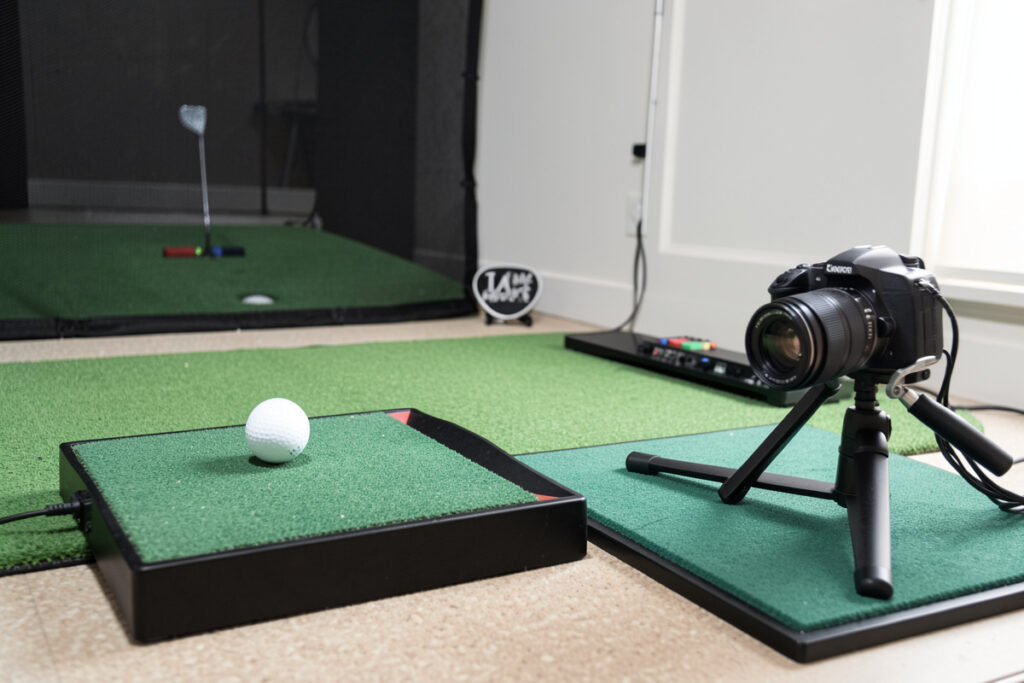
At the budget price, the real launch-monitor decision is not which brand — it is which technology: radar (Doppler) or photometric (camera). I run one of each against the same swings in my sim room, and the honest answer is that neither wins outright. Each one trades something away to hit a sub-$1,000 price, and the right pick is whichever set of compromises fits your room and your lighting. This guide lays out exactly what each road gives you and what it takes.
If you have not yet read the wider picture, this fits inside my budget launch monitor guide; here I go deep on the single fork that determines everything else about how your cheap monitor behaves.
How Each Technology Actually Works
A radar unit sits behind or beside the ball and uses the Doppler shift of a microwave signal to track the ball — and on some units the club — through the air. Because it watches flight, it needs to see enough of that flight to compute carry, which is why read distance behind the strike matters so much. Radar is inherently good outdoors and in varied light, since it is not looking at the ball with a camera at all.
A photometric unit sits beside or above the hitting area and photographs the ball at the instant of impact with high-speed cameras, reading speed, launch, and spin from the ball’s dimples and markings. Because it captures everything at impact rather than watching flight, it tolerates a much shorter room — but it is fussier about lighting, ball placement, and whether the ball is marked the way the unit wants. Two completely different physical approaches to the same question: what did the ball just do?
Read Distance vs Lighting: The Core Trade
The single most practical difference is what each technology demands of your space. Radar wants depth — a clean read corridor of several feet behind the ball, free of clutter that throws spurious returns. Starve a radar unit of that corridor and its carry numbers go feral; this is the number-one reason people think a budget radar unit is broken when it is simply boxed into a shallow room. If depth is your constraint, read my room depth breakdown before you buy radar.
Photometric wants light and consistency — even, controlled lighting and a ball placed in the exact capture zone every time, often marked. Give a camera unit poor light or an unmarked ball and its spin numbers, which look precise, become fiction. The upside is that it frees the floor behind you, so it suits shallow rooms and tight basements where a radar unit would starve. In my own room the lesson was blunt: the radar unit needed me to respect its corridor, and the camera unit needed me to respect its lighting. Same swings, two different demands.
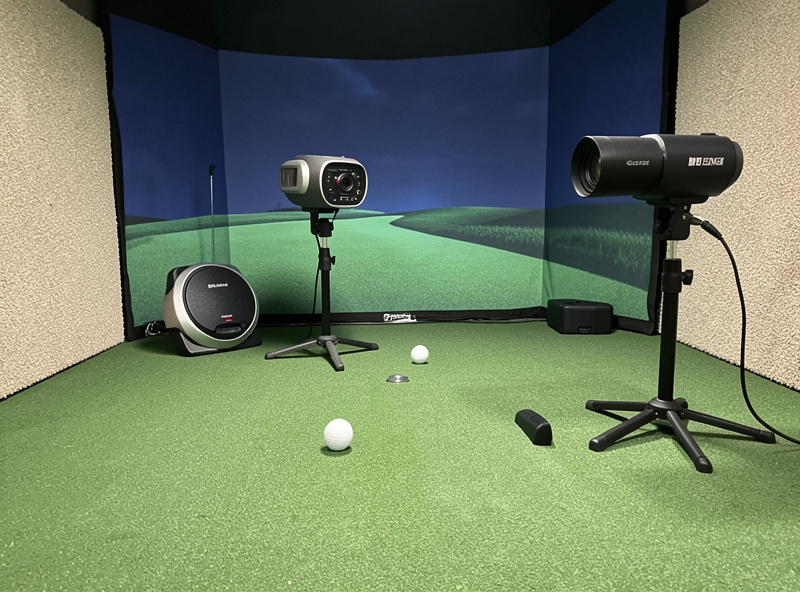
What Data Each One Trusts
Both technologies measure ball speed reliably — that is the anchor number across the whole budget category. Where they diverge is spin and the secondary data. A budget radar unit often models spin from speed and launch, which wanders on mishits; the most popular budget radar, the Garmin R10, is a textbook example, and I cover exactly where its numbers are calculated rather than measured in my Garmin R10 honest limits article. A budget photometric unit can read spin more directly from the ball’s markings — but only when the lighting is right and the ball is marked, which is the catch.
So the data trade looks like this: radar gives you robust ball speed and carry in a forgiving lighting environment, with spin you treat as a trend. Photometric gives you potentially better spin and launch, conditional on you controlling the light and marking the ball, in a room that can be shallow. Neither hands you measured club delivery at this price — that is the tier above, a separate conversation from this budget fork.
A Simple Way to Choose
| If your situation is… | Lean toward… |
|---|---|
| Deep room, can leave space behind the ball | Radar |
| Shallow room, tight front-to-back | Photometric |
| You want to use it outdoors / at the range too | Radar |
| You can control lighting and will mark balls | Photometric |
| Lighting is variable or hard to control | Radar |
| Spin fidelity matters more than convenience | Photometric (with good light) |
Read the row that matches your real space, not your ideal one. Most budget buyers over-index on data fields in the spec sheet and under-index on whether their room can actually feed the technology they picked. Decide the technology first, then choose a specific unit inside it — that order saves a lot of returns.
It is worth noticing how often the two technologies suit opposite kinds of homes. The deep, dim basement that struggles to light a camera unit is exactly where a radar unit thrives, because radar does not care about light and it has the depth it craves. The bright, shallow spare room that starves a radar unit of read distance is exactly where a photometric unit shines, because it captures at impact and you can control the light. Your room is rarely neutral — it usually pushes you toward one road, and the smart move is to listen to it rather than fight it. I have watched more than one builder buy the technology a forum told them was “more accurate,” force it into a room that could not feed it, and end up with worse data than the cheaper, better-matched alternative would have given them.
The Honest Bottom Line
If I had to hand someone a one-line rule: deep room and outdoor use, go radar; shallow room and controllable light, go photometric. Either way the budget-data rules hold — ball speed and dispersion are your friends, spin is a trend, and club data is a tier-up purchase. Match the road to the room, set the unit up to its own rules, and a sub-$1,000 monitor of either kind becomes genuinely trustworthy for the things it measures. To put it all together with room-sizing first, start at the room requirements guide and work back to the monitor.
Frequently Asked Questions
Is radar or photometric better for a budget golf launch monitor?
Neither is better in the abstract; each trades something to hit a budget price. Radar wants room depth and tolerates varied lighting, suiting deeper rooms and outdoor use. Photometric tolerates a shallow room but wants controlled lighting and often a marked ball. Match the technology to your space before comparing specific units.
Why does a radar launch monitor need so much room behind the ball?
A radar unit computes carry by watching enough ball flight through the Doppler shift of its signal. It needs a clean read corridor of several feet behind the strike, free of clutter that throws spurious returns. A shallow room starves it of that flight, and the carry numbers degrade as a result.
Do photometric launch monitors need a marked ball?
Often yes for reliable spin. Photometric units read spin from the ball’s dimples and markings at impact, so a marked ball oriented the way the unit wants, in good lighting, gives the cleanest spin data. Without that, spin readings can look precise but drift from reality.
Can a budget launch monitor measure club data?
Not reliably at this price. Genuine club path, face angle, and angle of attack require the instrument to see the club through impact, which is largely a higher-tier feature. Budget units that report club data usually model it, so treat those fields as approximate rather than measured.
Which technology is better outdoors?
Radar, in general. Because it tracks the ball through the air using a microwave signal rather than photographing it, a radar unit handles varied outdoor lighting well and is naturally suited to the range. Photometric units depend on controlled lighting, which is harder to guarantee outdoors.
Does the technology affect which numbers I can trust?
Yes. Both measure ball speed well. Radar tends to model spin, so treat spin as a trend; photometric can read spin more directly but only with good light and a marked ball. Choose based on which compromise your room and lighting can actually meet.
Related Guides
- Budget launch monitor guide — the full sub-$1,000 decision
- Garmin R10 honest limits — the budget radar unit, edges and all
- Golf simulator room depth — the dimension radar lives on