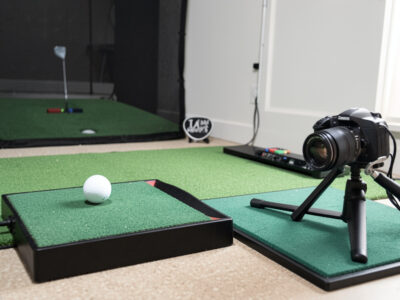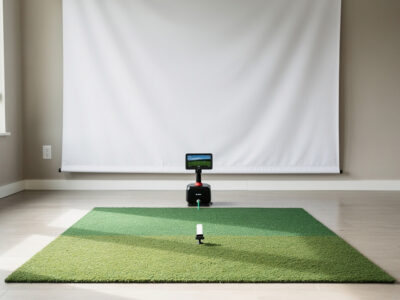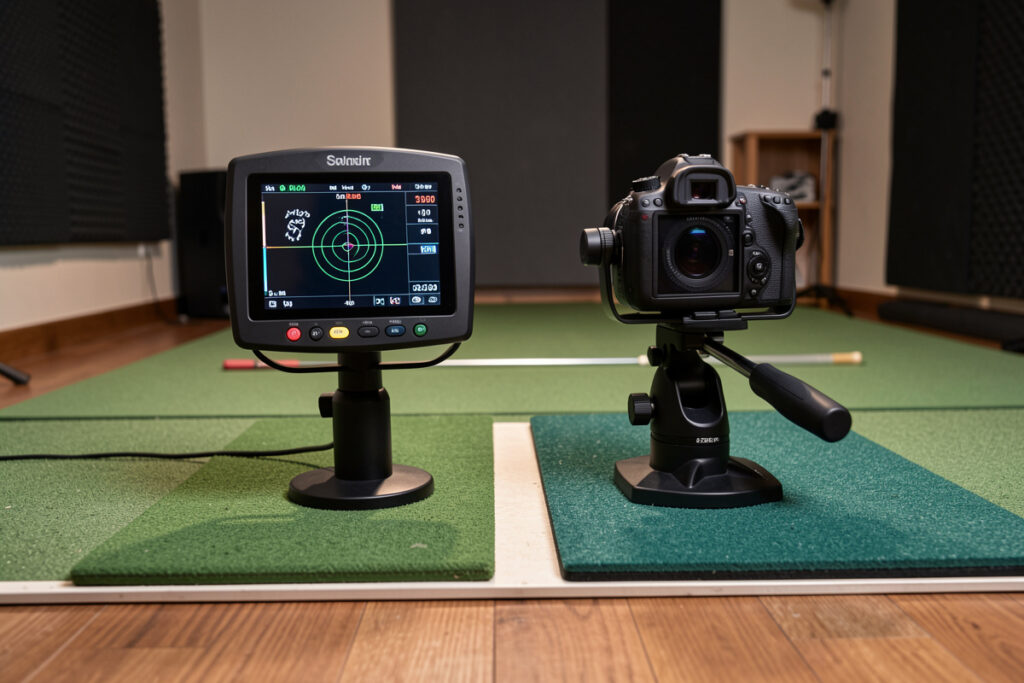
The most common cross-shop in the budget launch-monitor world pits the Garmin Approach R10 against the Rapsodo MLM2PRO — and it is really a proxy for the bigger question: radar or photometric at the sub-$1,000 price? I have run radar and camera units against the same swings all winter, and the honest answer is that this is a room-and-priorities decision, not a clear winner. Here is how the two technologies actually differ where it counts, so you can pick the one your space and goals reward.
This is the head-to-head companion to my budget launch monitor guide and my radar vs photometric breakdown — read those for the category logic; this one applies it to the specific decision people agonize over most.
Two Different Instruments, Not Two Versions of One
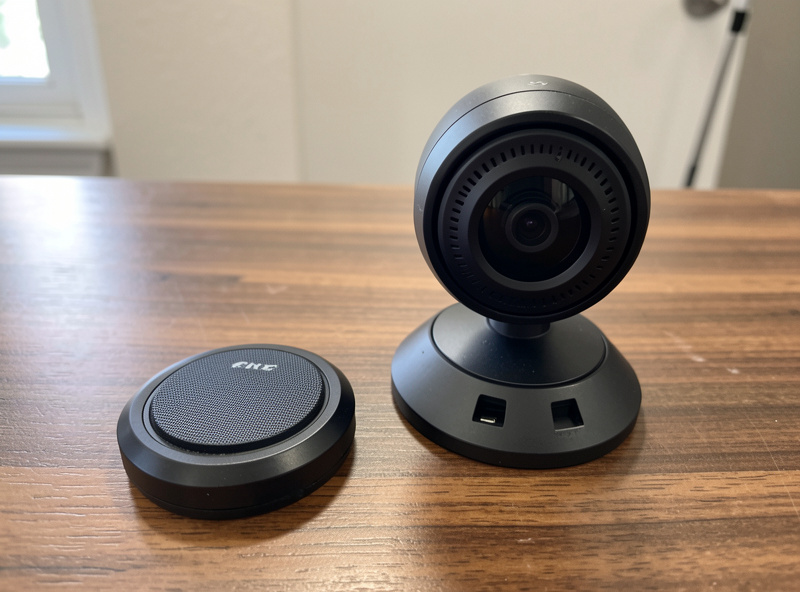
The R10 is a Doppler radar unit: it sits behind the ball and tracks flight to compute its numbers. The MLM2PRO is a photometric (camera) unit: it sits beside the hitting area and photographs the ball at impact. That single difference cascades into everything — the room each one needs, the data each trusts, and the conditions each demands. Comparing them is not comparing two trims of the same car; it is comparing two roads to the same destination, each with its own tolls.
Because of that, the “which is more accurate” question is the wrong frame. Each is accurate at the things its technology captures well and softer at the things it has to model. The right question is: which one’s strengths line up with your room and your goals, and which one’s weaknesses can you live with?
Where They Diverge
| Factor | Garmin R10 (radar) | Rapsodo MLM2PRO (photometric) |
|---|---|---|
| Technology | Doppler radar, tracks flight | Camera, captures at impact |
| Room depth needed | More — wants read distance behind ball | Less — fits shallower rooms |
| Lighting sensitivity | Low — works in varied light | Higher — wants controlled light |
| Marked ball | Not required | Helps for reliable spin |
| Spin data | Often modeled — trend only | Can be read more directly with good light |
| Outdoor / range use | Strong | Workable but lighting-dependent |
| Best-fit room | Deeper rooms, indoor + outdoor | Shallow rooms with controllable light |
Read the depth and lighting rows first — they decide more than any data-field comparison. If your room is deep and your lighting is whatever it happens to be, the radar R10 is the natural fit. If your room is shallow but you can control the light and will mark your balls, the photometric MLM2PRO suits the space the R10 would struggle in. I dig into exactly where the R10’s numbers are modeled in my Garmin R10 honest limits article, which is the radar half of this comparison in full.
The Data Reality on Both
Both units measure ball speed reliably — that is the anchor across the budget tier. The real divergence is spin. The R10 models spin for most shots, so you read it as a trend; the MLM2PRO can read spin more directly from the ball’s markings, but only when the lighting cooperates and the ball is marked. Neither gives you genuinely measured club-delivery data at this price — that is the tier above, a separate decision from this one. So if your dream is working on measured club path, neither of these is your answer, and it is better to know that now.
For what most budget buyers actually do — gapping clubs and tightening dispersion through a winter — both units are plenty, and the data-trust rules from my what data to trust at this price guide apply to each: trust ball speed and dispersion, treat spin and club fields as trends. Read either unit’s output as a cloud, not a point, and both behave honestly within their envelopes.
It is also worth being honest about the failure modes, because they differ. When the R10 disappoints, it is almost always a read-distance problem — a shallow room or a cluttered path behind the ball starving the radar of flight, which shows up as wild carries. When a photometric unit like the MLM2PRO disappoints, it is almost always lighting or ball presentation — dim or uneven light, or an unmarked ball, which shows up as spin numbers that look precise and drift. Knowing each unit’s characteristic failure tells you what to fix before you blame the hardware, and it tells you in advance which problem your room is more likely to hand you. A bright, shallow room will frustrate the radar; a dim, deep room will frustrate the camera. Match the unit to the room you actually have, not the one in the marketing photo.
How I Would Choose
My decision rule is blunt. Deep room, want outdoor and range use, do not want to fuss with lighting: the radar R10. Shallow room, can control the light, willing to mark balls and want a shot at more direct spin: the photometric MLM2PRO. Everything else — app preferences, software ecosystems, simulator features — is a tiebreaker, not the main event. Pick the technology your room rewards, and you will be happy with either; fight your room with the wrong technology, and you will be frustrated with the best unit in the class.
And whichever you choose, spend what is left on the room and mat rather than agonizing over the last spec. A budget monitor of either kind, set into a properly sized space, outperforms the other crammed into a room that does not suit it. Size the space first with my room requirements guide, check depth for radar with the room depth breakdown, and if you are shopping secondhand, run the checklist in buying a used launch monitor before you pay.
As an Amazon Associate I earn from qualifying purchases. Links below are to product searches, not specific listings.
To shop the radar road, look at a Garmin Approach R10 radar launch monitor; for the camera road, a Rapsodo MLM2PRO photometric launch monitor is the direct alternative. Either way, a set of marked practice balls is worth having, especially if you go photometric.
Frequently Asked Questions
Is the Garmin R10 or Rapsodo MLM2PRO better?
Neither wins outright; it is a room-and-priorities decision. The R10 is a radar unit that wants room depth and tolerates varied lighting, suiting deeper rooms and outdoor use. The MLM2PRO is a photometric unit that fits shallower rooms but wants controlled lighting and a marked ball. Pick the technology your space rewards.
What is the main difference between the R10 and MLM2PRO?
The R10 is a Doppler radar that tracks ball flight and needs read distance behind the strike. The MLM2PRO is a camera unit that captures at impact and fits a shallower room but depends on good lighting. That single technology difference drives the room, lighting, and spin-data differences between them.
Which one measures spin better?
The MLM2PRO can read spin more directly from the ball’s markings, but only with controlled lighting and a marked ball. The R10 generally models spin, so you treat it as a trend. If reliable spin matters most and you can control lighting, the photometric unit has the edge; otherwise the difference narrows.
Do I need more room for the Garmin R10?
Usually yes. As a behind-ball radar unit, the R10 needs a clean read corridor of several feet behind the strike, so it wants more depth than the camera-based MLM2PRO, which captures at impact. In a shallow room, the photometric unit is often the more practical fit.
Can either measure club data accurately?
Not at a genuinely measured level at this price. Club path, face angle, and angle of attack require seeing the club through impact, which is largely a higher-tier feature. Both units focus on ball data, so if measured club delivery is your priority, look above the budget segment.
Keep Building
- Budget launch monitor guide — the full sub-$1,000 picture
- Radar vs photometric budget monitors — the technology fork in depth
- Garmin R10 honest limits — the radar half in full
- What data to trust at this price — reading either unit’s numbers