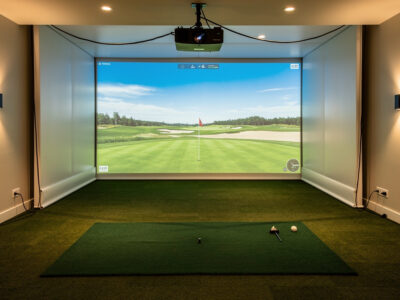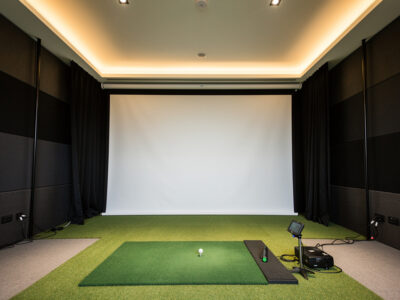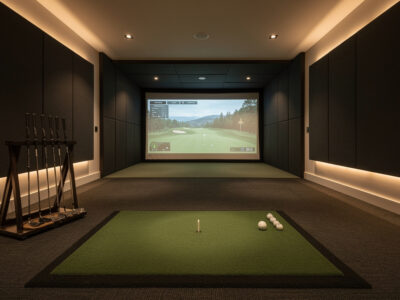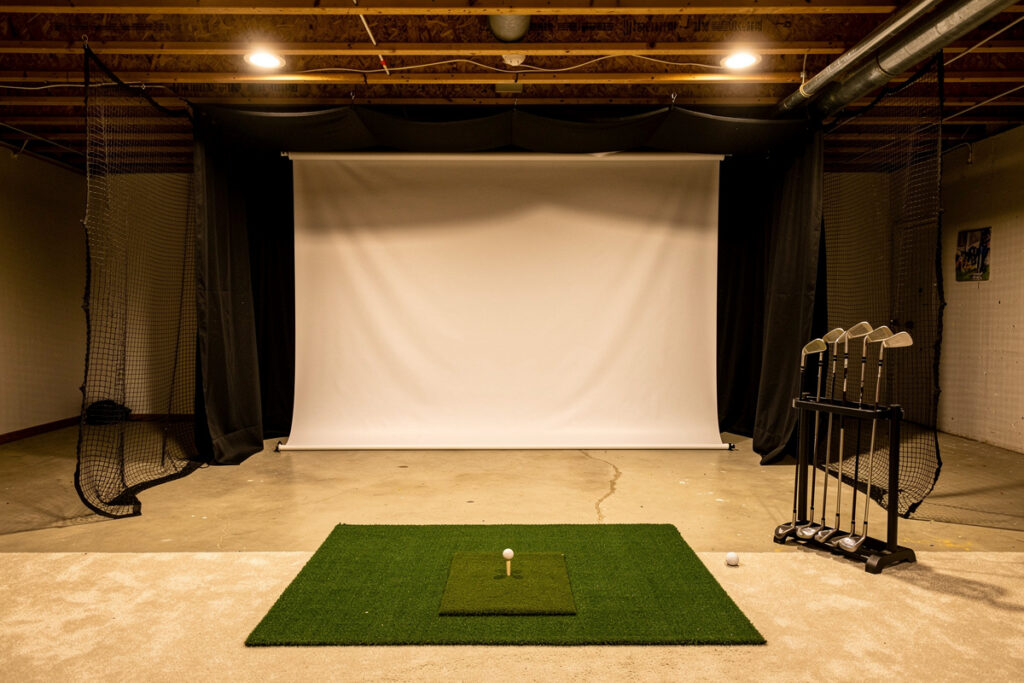
If your room has a low ceiling, you are not shut out of a home golf simulator — but a full-speed driver in an 8-foot room is unsafe, so the honest path is to match the swing to the space. The realistic options are choking down, shorter-shaft clubs, an iron-and-wedge practice room, and choosing a launch monitor that reads accurately on a restricted swing.
Low-ceiling builds are where the room-first doctrine pays off most, because pretending you have more height than you do leads to dented ceilings and a flinchy, useless swing. I would rather build a great 8-foot iron room than a dangerous 8-foot driver room. This guide walks through each option honestly — what it costs you in practice value, and which ones actually transfer to the course.
First, Measure What You Truly Have
Before choosing an option, confirm your real clearance by running the swing-arc test: address your hitting position, make a slow full swing, and mark the clubhead’s highest point. Then subtract the floor build-up your mat and base will add. That number — the true clearance under the lowest obstruction — tells you whether you are slightly short or genuinely low-ceiling, and the two situations call for different fixes.
This step matters because “low ceiling” covers a wide range. A room that is six inches short for a driver is a very different project from a room that tops out at 7 foot 6. The full method, including the hidden inches you lose, lives in the ceiling height guide; do that measurement before you spend on any of the workarounds below, because it changes which ones are even on the table.
Low ceilings show up most often in two spaces: basements pinched by ducts and beams, and garages where the door track eats the clearance. If a garage is your candidate room, the door-hardware trap is the first thing to check, and the garage reality guide covers exactly how to measure around it before you decide this is a low-ceiling build at all.
Option 1: Choke Down and Shorten the Swing
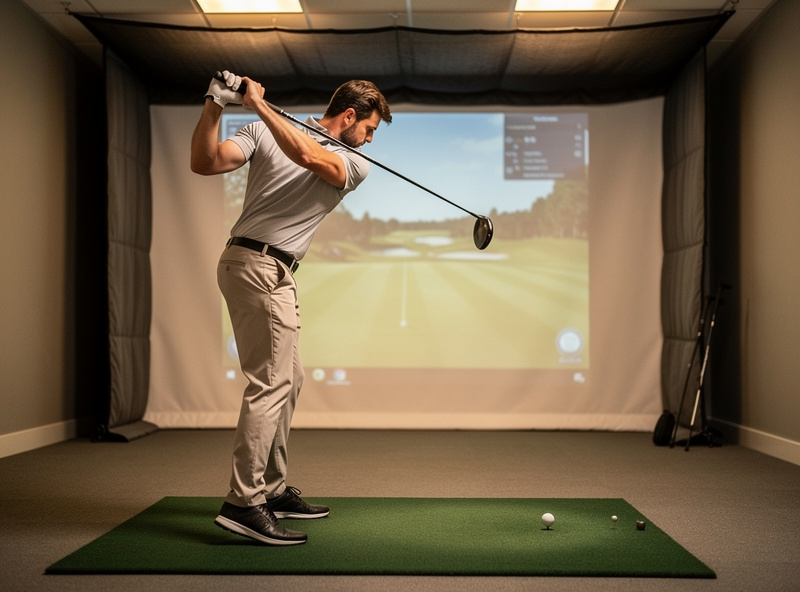
The cheapest fix is to choke down on the grip and make a more compact, three-quarter swing. Gripping down an inch or two and shortening the backswing lowers the top of your arc, and for a room that is only slightly short this can be enough to swing a driver safely. It costs nothing and you can try it tonight.
The trade-off is honesty about the data. A choked-down, shortened driver swing produces different numbers than your full swing — generally less clubhead speed and a slightly altered launch — so treat that data as practice feedback, not a true representation of your outdoor driver. For irons and wedges, where most golfers already swing more compactly, the compromise is far smaller and the practice transfers well.
Option 2: Shorter-Shaft Clubs
A more permanent fix is a set of shorter clubs, or a dedicated shorter driver, that physically lower your swing arc. A driver cut down or built shorter raises the top of the arc less, buying real ceiling clearance, and some golfers find a slightly shorter driver more controllable anyway. This is a genuine equipment change rather than a swing compromise.
If you go this route, keep the canon simple: shorter clubs change your numbers versus your gamers, so log them separately. A practical low-cost entry is a shorter-shaft driver kept purely as an indoor club, leaving your full-length gamers for the course. The point is not to retrain your swing around the room, but to give the room a club it can physically contain.
Option 3: Build an Iron-and-Wedge Room
For genuinely low ceilings, the most honest and often most useful option is to drop the driver entirely and build a room dedicated to irons, wedges, and short-game work. Most golfers lose more strokes inside 150 yards than off the tee, and a low room is perfectly suited to the exact swings — controlled iron and wedge motions — that need a lower arc and reward repetition.
A winter of focused wedge and iron practice transfers to the course more directly than a season of choked-down driver swings ever will. I treat this not as a consolation prize but as a legitimate, even superior, use of a constrained space — the room decides the swing, and a low room quietly points you at the part of your game that actually moves your scores.
Option 4: Choose a Forgiving Launch Monitor
Your monitor choice matters more in a low room, because some units need a fuller ball flight or a stable overhead mount that a low ceiling cannot provide. A behind-ball radar (Doppler) monitor sits on the floor and reads the strike without needing ceiling space for a mount, which makes it the friendliest pick when height is your binding constraint. For a full comparison of budget radar and photometric options at every price, see the budget launch monitor guide. An overhead photometric unit, by contrast, needs mounting height you may not have.
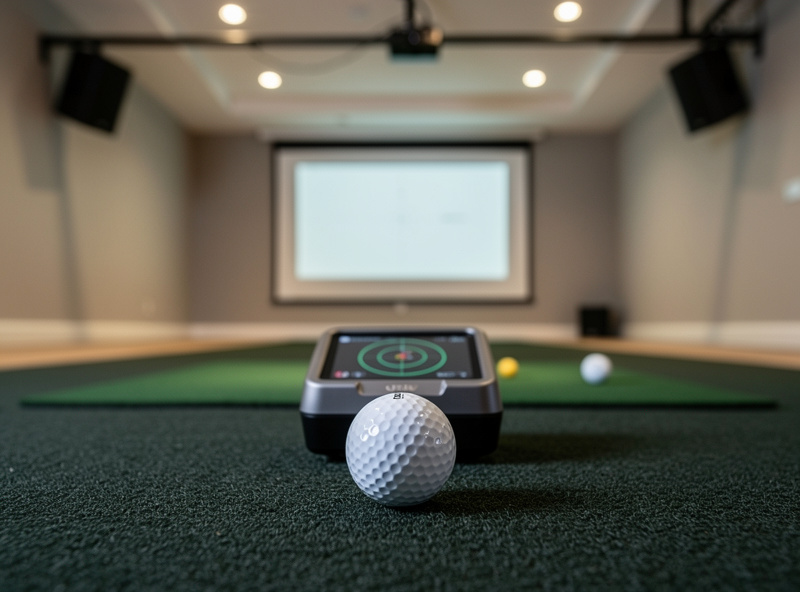
Match the monitor to the swing you will actually make. If you are building a compact iron room with shortened swings, pick a unit that reads accurately at impact rather than one that extrapolates from a long ball-flight read. A reliable portable radar launch monitor placed behind the ball is a sensible centerpiece for a low-ceiling build, leaving the ceiling free for your swing instead of a mount.

What Actually Transfers to the Course
Be clear-eyed about which low-ceiling practice helps your real game. Iron and wedge work in a constrained room transfers almost completely, because those swings are naturally compact and the data is honest. Choked-down driver swings transfer partially — the tempo and contact practice helps, but the speed and launch numbers are not your outdoor driver and should not be chased as if they were.
The biggest mistake low-ceiling builders make is treating restricted driver data as gospel and tinkering with their full swing based on numbers from a swing they only make indoors. Use the room for what it is good at, keep the driver data in its proper context, and your winter practice will sharpen the parts of your game a low room is genuinely suited to improve. The room is the first component — and a low room, used honestly, is still a very good one.
As an Amazon Associate I earn from qualifying purchases.
Frequently Asked Questions
Can you use a golf simulator with an 8-foot ceiling?
Yes, with adjustments. An 8-foot ceiling is usually too low for a full driver swing, but choking down, shorter clubs, or an iron-and-wedge focus all work. A behind-ball radar monitor avoids needing ceiling mount space, making it the friendliest choice.
What is the best launch monitor for a low ceiling?
A behind-ball radar (Doppler) monitor is usually best because it sits on the floor and needs no ceiling mount, unlike overhead photometric cameras. Choose one that reads accurately at impact rather than relying on a long ball-flight read in a tight room.
Does choking down on the driver affect my data?
Yes. A choked-down, shortened swing produces less clubhead speed and altered launch versus your full swing, so treat that data as practice feedback rather than a true picture of your outdoor driver. Iron and wedge data is affected far less.
Is an iron-only golf simulator worth it?
Often yes. Most golfers lose more strokes inside 150 yards than off the tee, and a low room suits the compact iron and wedge swings that reward repetition. A winter of focused short-game practice transfers to the course more directly than choked driver swings.
How low is too low for a golf simulator?
Below about 8 feet of true clearance, a full driver swing is unsafe for most adults. At that point, plan around shortened swings, shorter clubs, or an iron-and-wedge room. Always confirm your real clearance with a swing-arc test before deciding.
Further Reading
- Golf Simulator Room Requirements: The Complete Guide
- Golf Simulator Ceiling Height: How Much You Really Need
More from This Cluster
- “Golf Simulator Room Depth: The Three Zones Explained”
- “Golf Simulator Screen Distance: Safe and Sharp”
- “The Garage Golf Simulator Reality Check”
- “Room Width for a Golf Simulator: Centered and Safe”
- “Golf Simulator Ceiling Height: How Much You Really Need”
- “Golf Simulator Room Requirements: The Complete Tape-Measure Guide”