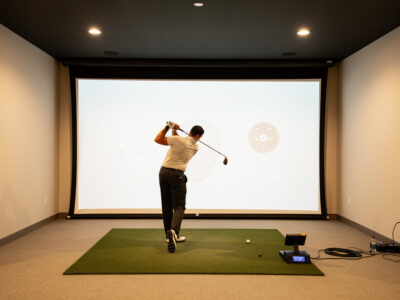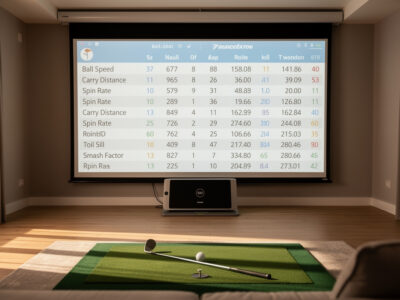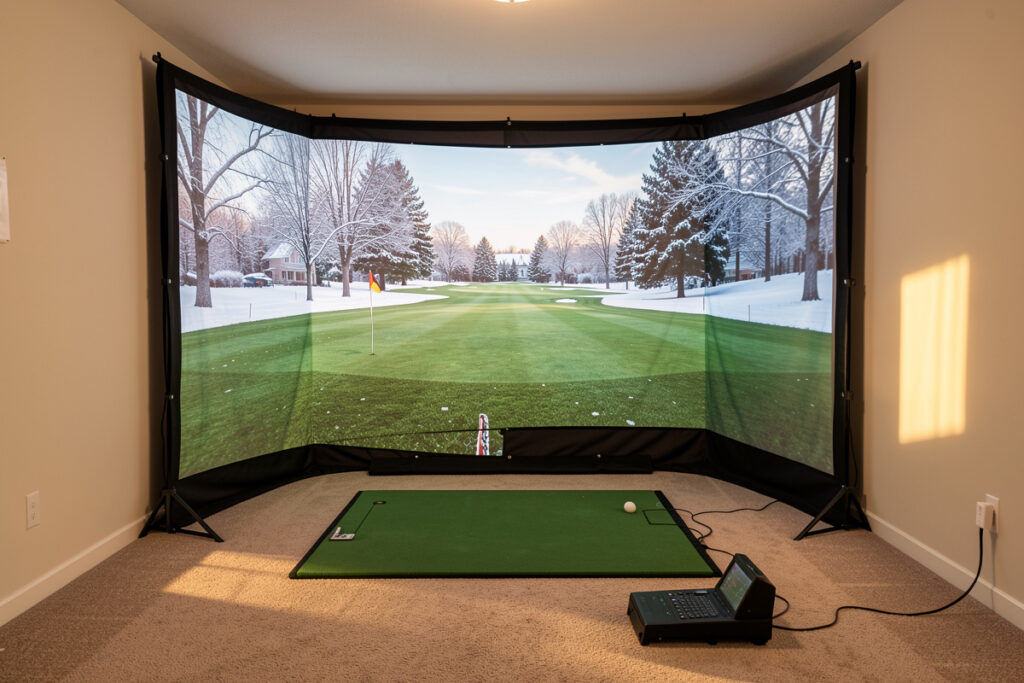
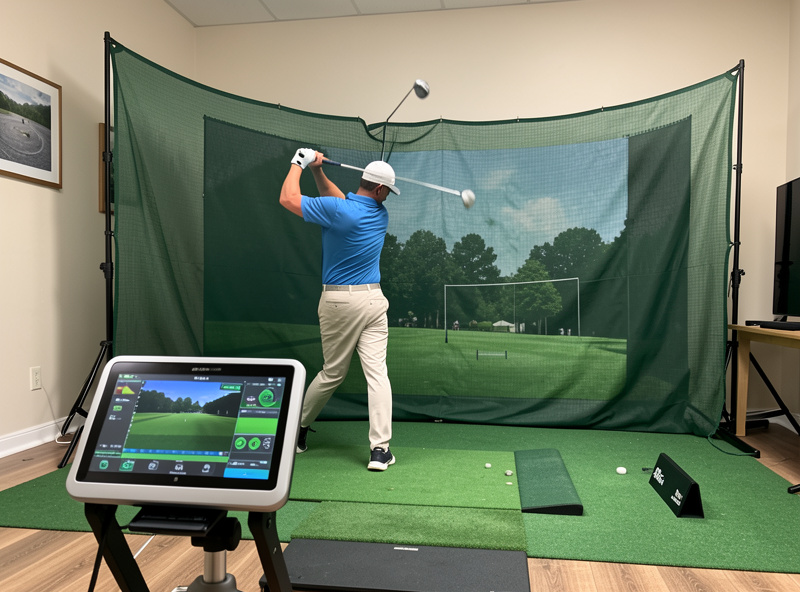
A structured golf sim practice guide beats random ball-beating because it turns a dead winter into measurable swing data. In my sim room I build the off-season around three blocks — full-swing reps, a wedge matrix, and dispersion tracking — so every session leaves a number behind, not just a tired back.
That is the whole idea behind this guide. Sweden gives me roughly five months where the course is frozen, and the simulator is the only place my swing stays alive. After enough winters of doing it badly, I stopped treating sim time as entertainment and started treating it as a build: a room that gives honest feedback, a launch monitor I trust, and a weekly structure that I can actually repeat. Below is the framework I run, the order I’d build it in, and the deeper guides for each block.
Why Winter Sim Practice Needs a Structure
Unstructured sim practice drifts toward the driver and the longest course you can load. Within a few weeks you have hit a thousand tee shots, learned nothing, and your wedges have gone cold. Structure fixes that by forcing time onto the parts of the game that actually decay over a winter.
The honest framing first: a golf simulator does not lower your handicap on its own, and I am not going to promise you a number. What it does is keep your movement pattern from rusting and give you data you literally cannot get on a frozen range — carry, spin axis, launch, dispersion — every single shot. The structure is what converts that raw data into something you can act on. Without it, the launch monitor is just a very expensive way to watch a ball hit a screen.
I think of the winter as a project with a deliverable: come spring, I want a swing that has not changed shape and a folder of dispersion screenshots that tell me exactly where my misses live. That is a measurable outcome. “Get better” is not.
There is a polymath habit underneath this for me. I came to golf sims from a sim-racing rig — same projector fights, same self-built PC, same screen-distance ergonomics — and racing taught me that a practice rig is only worth the data you can read off it. A lap time you cannot break down into corners is just a number; a swing you cannot break into carry, launch and dispersion is the same. The structure is what makes the rig a measurement instrument instead of a toy, and treating the winter that way is what separated my useful seasons from the wasted ones.
The Foundation Comes Before Any Drill
Before you structure a single session, two things have to be honest: the room and the data. A drill built on a swing you cannot finish, or on numbers you do not trust, is wasted winter. Get these right and everything downstream becomes useful.
The room is the first component. If you cannot make a full, committed driver swing without flinching at the ceiling, you will groove a shortened move all winter and walk onto the first tee in April with a swing you have to un-learn. My tape-measure room guide walks the minimums, and the ceiling-height article is the one most people get wrong — overhead radar and tall players both need more than the brochure suggests. If you are squeezed, the low-ceiling options piece covers what still works. Depth matters too; the three-zone depth breakdown explains why the screen offset is not negotiable.
The data is the second. A structured plan assumes the numbers mean something, so you need to know which metrics your monitor actually measures versus models. My guide to which budget launch monitor data to trust is the one to read first — on a Garmin Approach R10 I trust ball speed and carry far more than I trust club path, and I plan my drills around that. The radar versus photometric breakdown explains why, and the R10 honest-limits piece lists exactly where I stop believing my own unit.
Build the Winter Into Blocks
The framework I run splits every session into named blocks, and each block has a different job. The mistake is treating all sim practice as the same activity — block reps, variable practice, and on-course play train completely different things, and a structured winter uses all three on purpose.
Here is how I weigh them. Block practice is where you change something — a grip, a setup, a feel — and hit the same shot repeatedly to encode it. Variable (or random) practice is where you never hit the same shot twice, switching club and target every ball, which is far closer to real golf and the part most home setups skip. Play is loading an actual course in GSPro or E6 Connect and committing to one ball, full routine, consequences and all.
| Block Type | What It Trains | Sim Time Share | Data To Watch |
|---|---|---|---|
| Block practice | Encoding a single change or feel | ~30% | Consistency of one metric (e.g. launch) |
| Variable practice | Adapting club and target every shot | ~40% | Dispersion across clubs |
| Course play | Routine, commitment, decision-making | ~20% | Misses under one-ball pressure |
| Wedge matrix | Distance control inside full swing | ~10% | Carry gaps between numbers |
The percentages are how I split my own winter, not a law. The point is that if you only ever do block practice, you build a swing that works on a tee mat and falls apart when the situation changes. If you only ever play courses, you never fix anything. The structure forces both.
The order inside a single session matters as much as the weekly split. I open with a few minutes of slow, no-data swings to find tempo, then move to the day’s block while I am fresh and patient, because that is when encoding a change actually works. Variable practice comes second, when fatigue starts to creep in and adapting under mild tiredness is closer to the back nine anyway. Play, if it is a play day, comes last. Front-loading the change work is the difference between practice and just generating numbers; by the time I am tired I want the part of the session that tolerates tired.
Practice That Transfers Versus Sim Flattery
The single most important question in winter sim work is which of your numbers will survive contact with a real fairway. Some sim practice transfers beautifully to the course; some of it just flatters you because the mat, the perfect lie, and the forgiving physics hide your worst tendencies.
This deserves its own treatment, and I have given it two. My guide to golf sim practice that transfers covers the drills and habits that actually carry to grass — tempo work, alignment discipline, variable targeting, and routine. The companion piece on simulator flattery versus real golf is the uncomfortable one: a perfect mat lie removes the fat-shot penalty, the screen forgives your start line, and indoor numbers can quietly drift optimistic. Read both before you trust a winter of data, because knowing where the sim lies to you is what makes the rest of the data honest.
The Short Game Block: A Wedge Matrix Indoors
Wedges are the part of the game that decays fastest over a winter and the part a sim trains best, because distance control is pure data. A wedge matrix — clubs across the top, swing lengths down the side, carry numbers in the cells — turns vague “three-quarter” feels into a table you can actually own.
Building one indoors is the most transferable thing you can do in a sim, because carry distance is measured the same way on the screen as it is in the air. My full wedge practice matrix guide walks how I build mine each winter, why I anchor it to clock positions rather than effort percentages, and how to read the carry gaps so you know your real numbers when the season opens. This is the block I protect most jealously, because it is where the sim’s data is least flattering and most useful.
Measure With Dispersion, Not Score
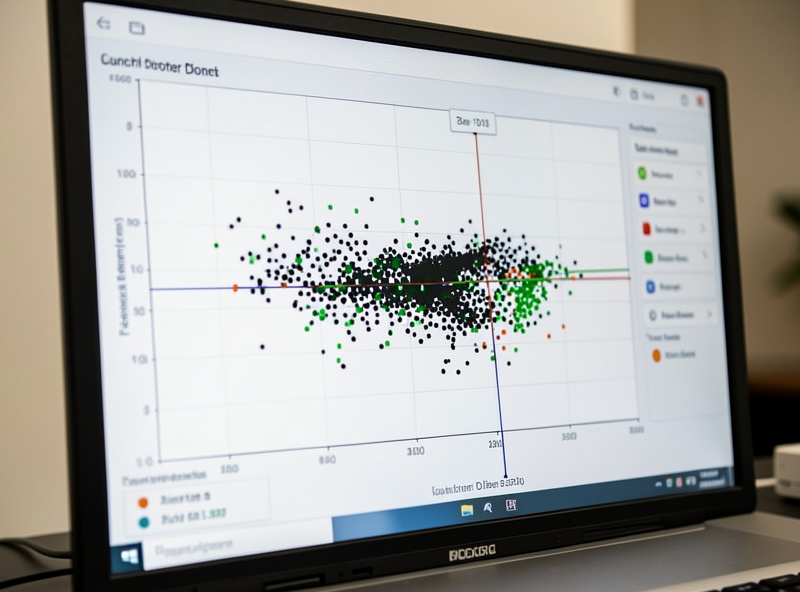
If you take one habit from this guide, make it this: track dispersion, not score. A sim score is a vanity number shaped by gimme putts and forgiving greens. Dispersion — how tightly your shots cluster around a target line — is real, measurable, and the honest record of whether your winter actually held your game together.
I am deliberate about the language here because it matters. Dispersion is data, not a performance promise. A tighter cluster on the screen does not guarantee a lower score on grass; wind, lies, and pressure all live outside the room. But a widening cluster is an early warning that something in the swing is drifting, and a stable one tells me the winter is doing its job. My dispersion tracking guide covers how I log it, what tools make it painless, and how to read the ellipse without lying to yourself. Pair it with the broader swing analysis data guide for the full picture of which numbers to chart over a winter.
A Sample Week In My Sim Room
Structure only works if it is repeatable, so here is a real winter week from my room — three sessions, roughly an hour each, because an hour of focused blocks beats three hours of mindless driver. The exact days flex around work; the shape does not.
Session one is the change session: block practice on one thing only. If I am working a flatter takeaway, I hit nothing but seven-irons watching launch and start direction, fifty balls, and I do not load a course. Session two is the variable session: every ball a different club and a different target on the range screen, never the same shot twice, watching dispersion club to club. Session three is play: eighteen holes in GSPro, one ball, full routine, and I log the misses. Once a week I add a short wedge-matrix block to keep the carry numbers current.
Three sessions, one change, one adaptation block, one round. That is the whole engine. It is boring on paper and that is exactly why it works — boredom is the sound of practice that transfers.
Software And Gear That Make A Block Work
You do not need expensive gear to run a structured winter, but a few things remove friction. The software is the biggest lever: a sim platform with a real range mode and per-shot data is what makes variable practice and dispersion tracking possible at all.
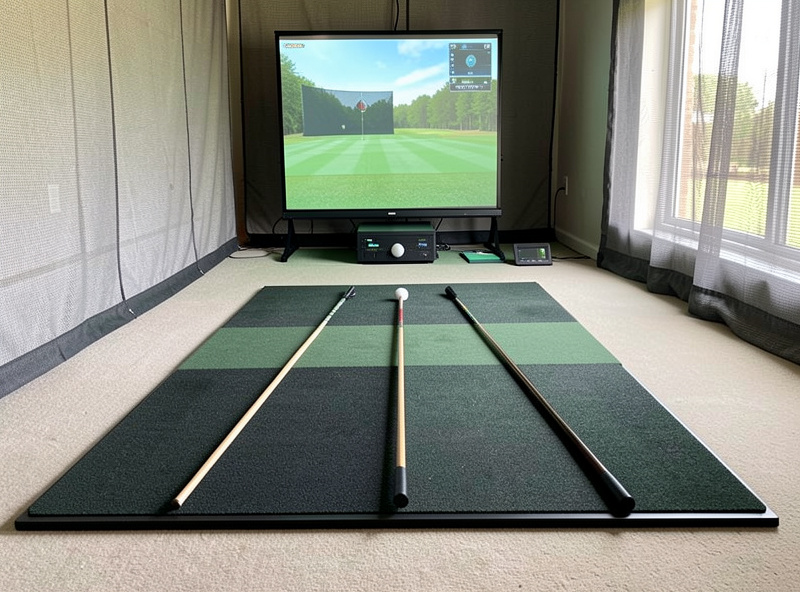
GSPro is my daily driver for exactly this reason — its range and the data overlay make block work painless, and the comparison with E6 Connect covers the trade-offs if you want curated courses over open physics. For league nights that keep winter motivation alive, the multiplayer guide is worth a read. On hardware, a mat that gives honest lie feedback protects both your wrists and your data; a budget mat that ignores fat shots is flattery you pay for in spring. A set of alignment sticks is the cheapest practice upgrade there is — I keep a pair on the mat every session for start-line work. Alignment sticks are a few dollars and do more for transfer than any gadget.
As an Amazon Associate I earn from qualifying purchases.
For the launch monitor itself, do not over-buy before the room is right — my under-$1,000 launch monitor guide and the R10 versus MLM2PRO comparison cover what your dispersion and carry data are actually worth at each tier. The room budget buys more practice value than the next monitor up, every time.
The Mat Is Part Of Your Data
People obsess over the launch monitor and treat the mat as a floor covering. That is backwards. The mat sits between your club and the ground every single shot, and a bad one quietly corrupts a whole winter of structured practice by removing the one penalty grass never forgives.
Here is the mechanism. A cheap, dense turf mat lets the club bounce into the ball even when you hit two inches behind it, so a fat shot that would have died on the course shows up on the screen as a decent number. Run a wedge matrix on that mat and your carry figures are flattered; run dispersion tracking on it and your cluster looks tighter than your real strike pattern deserves. A mat that gives honest lie feedback — that punishes a heavy strike with a visibly worse number — is what keeps the data trustworthy. When I compare a premium fairway-feel mat against a budget pad in my room, the budget pad always reads kinder, and kinder is exactly what you do not want from a practice tool. Think of the mat as a calibration surface, not furniture, and budget for it before the next monitor tier.
Keeping Motivation Alive Through A Dead Season
Structure fails if you stop showing up, and five months is a long time to grind blocks alone. The unglamorous truth is that a winter plan needs a motivation layer or it dies in January, so I build variety and a little social pressure into the schedule on purpose.
The biggest lever is the round itself. Loading a real course in GSPro and playing eighteen with one ball keeps the blocks meaningful — you are practicing for something, not into a void. League nights add accountability; the multiplayer and league guide covers how a weekly GSPro lobby kept my winter honest when willpower ran thin. I also rotate the change session so block practice never goes stale — one fortnight it is takeaway, the next it is a low-flighted stock shot. The variety is not indulgence; it is what gets you back in the room often enough for the structure to matter. A perfect plan you abandon in week three trains nothing.
Frequently Asked Questions
How many days a week should I practice in a golf sim over winter?
Three focused hour-long sessions a week is plenty. In my room I run one change session, one variable-practice session, and one round. Frequency matters less than structure; three deliberate hours beat ten aimless ones for keeping a swing from rusting.
Does golf sim practice actually transfer to real golf?
Some of it transfers well and some flatters you. Tempo, alignment, distance control and routine carry to grass. A perfect mat lie and forgiving screen physics can hide fat shots and start-line errors, so the data needs honest reading rather than blind trust.
Should I track my score or my dispersion in a golf sim?
Track dispersion. Sim scores are inflated by gimme putts and forgiving greens. Dispersion, how tightly your shots cluster around a target line, is measurable data that tells you whether your swing is holding together. It is a record, not a score-improvement promise.
What is the most useful single block of sim practice?
A wedge matrix. Distance control is pure measured data, it transfers directly because carry is carry, and wedges decay fastest over a winter. Building a clubs-by-swing-length carry table each winter is the highest-value indoor block I run.
Do I need an expensive launch monitor for structured practice?
No. A budget radar unit like the Garmin Approach R10 gives trustworthy carry and ball speed, which is enough for dispersion and wedge work. Spend on the room and the mat before the next monitor tier; the room buys more practice value than data precision does.
What software is best for structured winter practice?
GSPro is my daily driver because its range mode and per-shot data make block and variable practice easy. E6 Connect leans toward curated courses. For structured drills you want a real range with a data overlay more than you want a pretty course list.